
Up to 70% IBF funding* T&Cs Apply , Cybersecurity Solutions 1
Up to 70% IBF funding* 2
Up to 70% IBF funding* T&Cs Apply , Cybersecurity Solutions 3
Up to 70% IBF funding* T&Cs Apply 4

Why Emotional Trading Is Costing Retail Investors Millions in 2026
Fear. Greed. FOMO. Panic selling. In today’s volatile markets, emotional decision-making may be one of the biggest threats to long-term investing success.
Markets are moving faster than ever.
Artificial Intelligence stocks are surging. Global indexes continue reaching new highs. Financial news spreads instantly across social media, trading apps, and AI-powered platforms.
Every day, investors are flooded with:
- Breaking market headlines
- Viral stock predictions
- “Hot” AI stock picks
- Fear-driven recession warnings
- Overnight trading success stories
For many retail investors, the pressure to react quickly has never been higher.
But beneath the surface, a dangerous problem is growing:
Emotional trading is silently destroying long-term investment performance.
And in 2026, this problem may be more serious than ever before.
What Is Emotional Trading?
Emotional trading happens when investors make decisions based primarily on:
- Fear
- Greed
- Excitement
- Panic
- Impatience
- Social pressure
Instead of following a structured investment framework, emotional traders often react impulsively to short-term market movements.
This usually leads to:
- Buying too late
- Selling too early
- Chasing hype
- Overtrading
- Poor risk management
- Inconsistent investing results
In volatile markets, emotions can become extremely expensive.
Why Emotional Trading Is Becoming More Common
Modern financial markets are designed to trigger emotional reactions.
Today’s investors are constantly exposed to:
- Real-time market notifications
- Social media opinions
- AI-generated predictions
- Fear-driven headlines
- Extreme market volatility
Unlike previous generations, investors now receive nonstop information every minute of the day.
While access to information has improved dramatically, it has also increased emotional pressure.
Many investors feel:
- They must constantly react
- They are “missing out”
- They need to trade more frequently
- Everyone else is making money faster
This creates dangerous psychological behaviour.
Because investing success rarely comes from emotional reactions.
The Psychology Behind Market Mistakes
Human psychology plays a massive role in financial markets.
Two emotions dominate investing behaviour:
Fear and greed.
Fear causes investors to:
- Panic sell during corrections
- Exit strong investments too early
- Avoid opportunities during uncertainty
Greed causes investors to:
- Chase overextended stocks
- Ignore risk management
- Overestimate short-term gains
- Take excessive risks
These emotional cycles repeat constantly across every market generation.
Even experienced investors can struggle emotionally during volatile periods.
That is why successful investing is often more psychological than technical.
The Rise of FOMO Investing
One of the biggest emotional traps in 2026 is:
FOMO — Fear of Missing Out.
Social media has amplified this dramatically.
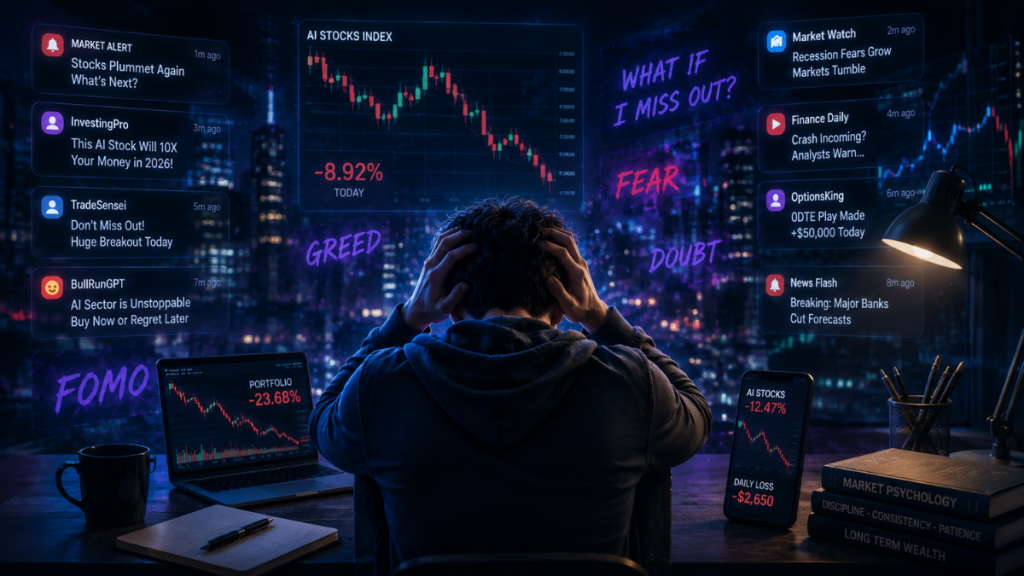
Investors constantly see:
- Massive profit screenshots
- Viral stock predictions
- AI stock hype
- Crypto rallies
- “Easy money” narratives
This creates emotional pressure to participate immediately.
Many investors end up:
- Buying at unsustainable prices
- Entering trades too late
- Ignoring proper research
- Taking risks they do not fully understand
Unfortunately, markets often punish emotional chasing.
By the time a trend becomes popular online, much of the easy opportunity may already be gone.
Why Risk Management Matters More Than Ever
One of the biggest differences between professional investors and emotional traders is risk management.
Experienced investors understand:
Protecting capital comes first.
They focus heavily on:
- Position sizing
- Portfolio allocation
- Risk-to-reward ratios
- Strategic entries
- Downside protection
Emotional traders often ignore these principles.
Instead, they:
- Overcommit capital
- Trade impulsively
- Increase position sizes emotionally
- React emotionally to losses
This creates long-term inconsistency.
In modern markets, risk management may be more important than stock selection itself.
Technology Has Made Emotional Trading Worse
Ironically, modern technology has made emotional investing easier.
Today:
- Trades can be executed instantly
- Market news spreads globally within seconds
- AI-generated opinions flood social media
- Investors can access markets 24/7
While technology improves convenience, it also increases emotional impulsiveness.
Many investors now trade too frequently simply because they can.
But more activity does not necessarily lead to better results.
In fact:
Overtrading is one of the most common signs of emotional investing.
Why Structured Investing Frameworks Matter
Successful investors rarely rely on emotions alone.
Instead, they develop structured systems.
This may include:
✅ Defined entry and exit rules
✅ Risk management frameworks
✅ Portfolio allocation strategies
✅ Market analysis systems
✅ Long-term investing plans
Frameworks help investors:
- Stay disciplined
- Reduce impulsive decisions
- Navigate uncertainty more calmly
- Maintain consistency during volatility
Without structure, emotions eventually dominate decision-making.
And emotional decisions often lead to inconsistent outcomes.
The Importance of Financial Education
In today’s fast-moving markets, financial education has become increasingly valuable.
Learning properly helps investors:
- Understand market cycles
- Improve emotional discipline
- Build risk awareness
- Develop long-term strategies
- Avoid common investing mistakes
Unfortunately, many beginner investors focus only on:
- finding winning stocks
instead of: - learning proper investing habits
But successful investing is rarely about one lucky trade.
It is usually the result of:
- consistency
- discipline
- patience
- continuous learning
Why Discipline Still Wins in the Long Run
Markets will always fluctuate.
There will always be:
- Bull markets
- Corrections
- Fear-driven selloffs
- New technologies
- Economic uncertainty
- Market hype cycles
But throughout history, disciplined investors have consistently outperformed emotional decision-makers over the long term.
Because investing success is not simply about reacting faster.
It is about:
- controlling emotions
- managing risk
- staying patient
- making informed decisions consistently
This is where emotional discipline becomes one of the most valuable investing skills.
Final Thoughts
In 2026, emotional trading may be one of the biggest hidden risks facing retail investors.
Modern technology, AI-generated content, social media hype, and constant market noise have created an environment where emotional decision-making becomes increasingly difficult to avoid.
But successful investing still depends heavily on:
- Discipline
- Risk management
- Patience
- Education
- Structured thinking
Because while markets evolve constantly,
human emotions remain remarkably consistent.
And in volatile markets, investors who learn how to manage emotions effectively may develop one of the strongest long-term advantages of all.