
Up to 70% IBF funding* T&Cs Apply , Cybersecurity Solutions 1
Up to 70% IBF funding* 2
Up to 70% IBF funding* T&Cs Apply , Cybersecurity Solutions 3
Up to 70% IBF funding* T&Cs Apply 4

Why Most Retail Traders Lose Money in Today’s Market And How Smart Investors Stay Ahead
The modern market is moving faster than ever. Here’s why having the right investing knowledge, trading tools and market framework matters more today than ever before.
The Stock Market Is Hitting New Highs But Many Traders Are Still Losing Money
Artificial Intelligence stocks are soaring.
Global markets continue climbing despite inflation concerns, geopolitical conflicts and uncertainty around interest rates.
Every day, social media is filled with:
- “10X stock opportunities”
- Viral trading screenshots
- AI stock hype
- Overnight success stories
- Aggressive crypto predictions
To many beginners, investing in 2026 looks easy.
But behind the scenes, a different reality exists.
Thousands of retail traders are still:
- Buying at the top
- Panic selling during pullbacks
- Overtrading emotionally
- Losing money from poor risk management
- Following hype without understanding the market structure
The truth is simple:
The market rewards disciplined investors, not emotional traders.
And in today’s volatile environment, learning with the right tools and proper investing education has become more important than ever.
Why Trading Feels Harder in Today’s Market
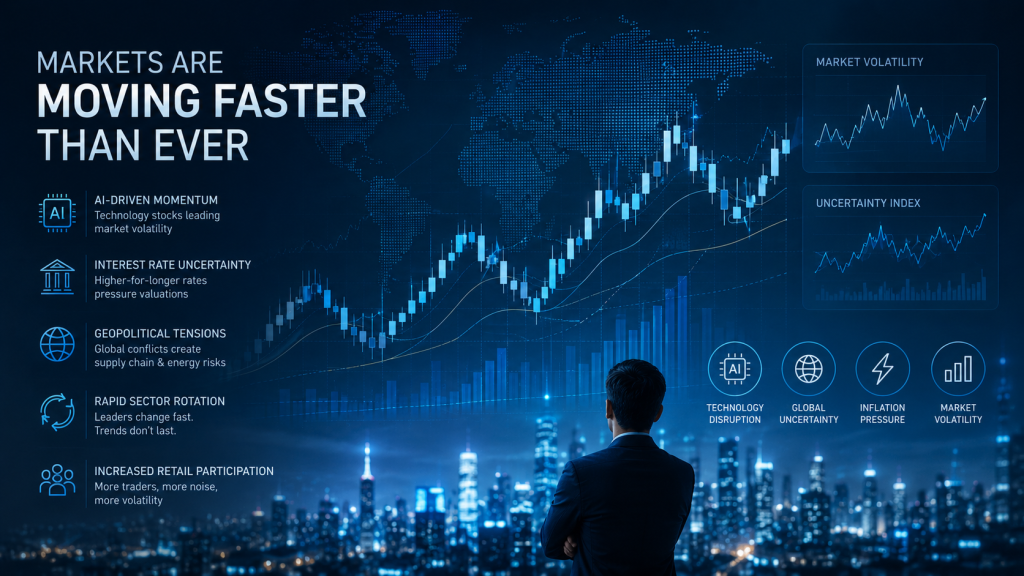
The financial markets have changed dramatically over the last few years.
Today’s market is heavily influenced by:
- Artificial Intelligence (AI) momentum
- Institutional algorithmic trading
- Interest rate uncertainty
- Geopolitical tensions
- Rapid sector rotation
- Social media-driven speculation
This creates extreme volatility.
Stocks can rally aggressively one week then collapse the next.
Many traders struggle because they rely purely on:
- Guesswork
- Online opinions
- Random indicators
- Emotional reactions
- “Hot stock tips”
Without a structured framework, most people eventually lose consistency.
The Biggest Mistake Beginner Investors Make
One of the most common investing mistakes today is believing that:
More information automatically leads to better investing decisions.
But information is everywhere now.
Anyone can access:
- Financial news
- YouTube analysis
- AI-generated stock commentary
- Free charting platforms
- Market opinions on social media
The real problem is not lack of information.
The real problem is:
Knowing how to filter noise from reality.
Successful investors understand:
- When to enter
- When to stay patient
- How to manage risk
- How market psychology works
- How to avoid emotional decision-making
This is why proper investing education matters.
Why Learning Investing and Trading Properly Matters
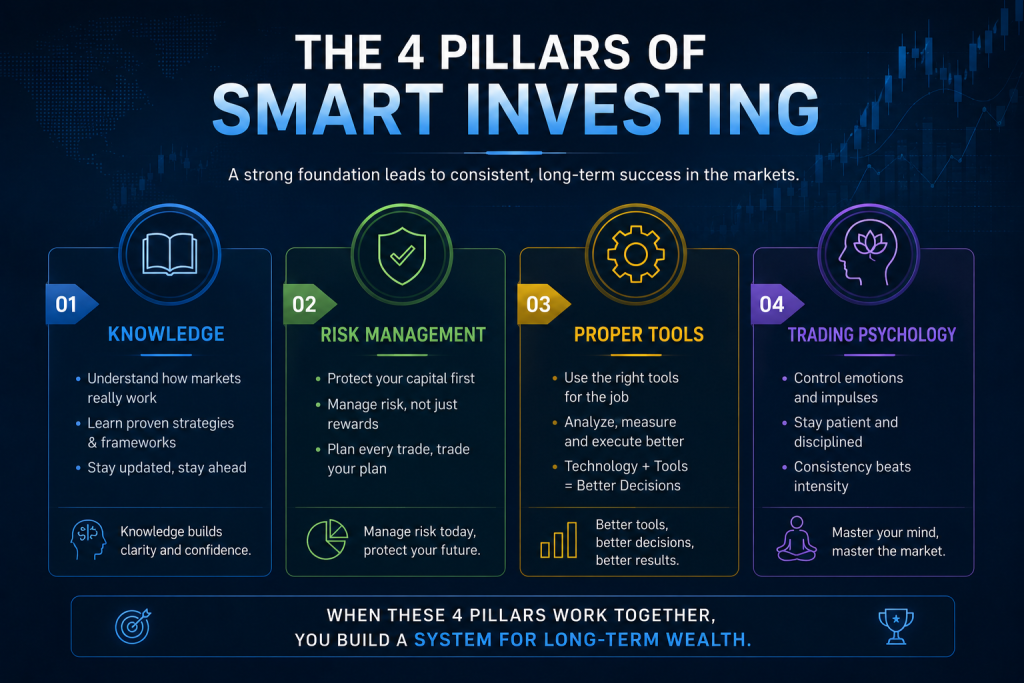
Many people enter the market hoping for quick profits.
Few spend enough time learning:
- Risk management
- Technical analysis
- Market cycles
- Position sizing
- Portfolio allocation
- Trading psychology
Without these foundations, even a good stock pick can turn into a bad trade.
Learning properly helps investors:
✅ Avoid emotional trading
✅ Build long-term consistency
✅ Improve risk management
✅ Develop structured decision-making
✅ Navigate volatile markets more confidently
The goal is not simply to trade more.
The goal is to make smarter decisions consistently.
Why the Right Trading Tools Matter in 2026
Modern investing is no longer just about buying stocks randomly.
Professional traders and experienced investors use tools to:
- Analyse price action
- Track momentum
- Monitor volume
- Identify market trends
- Manage downside risk
- Improve timing and execution
The right trading tools provide structure.
They help remove emotional decision-making during volatile market conditions.
Some examples include:
- Technical charting software
- Volume analysis tools
- Relative strength indicators
- Risk management systems
- Market scanning platforms
But here’s the important part:
Tools alone do not create successful traders.
Without proper knowledge, many beginners misuse indicators and overcomplicate their strategy.
That’s why combining:
- Education
- Experience
- Discipline
- Proper tools
creates a far stronger investing foundation.
Emotional Trading Is Costing Retail Investors Millions
One of the biggest reasons traders lose money is emotional behaviour.
This includes:
- Fear of missing out (FOMO)
- Panic selling during corrections
- Revenge trading after losses
- Overconfidence during bull markets
- Chasing trending stocks too late
Markets are designed to test emotions.
Successful investors rely on:
- Structured systems
- Clear frameworks
- Defined risk management
- Repeatable strategies
Not emotional reactions.
The Most Successful Investors Focus on Risk First
Professional investors understand an important principle:
Protecting capital is more important than chasing profits.
This mindset separates long-term investors from short-term gamblers.
Experienced traders focus heavily on:
- Downside protection
- Position sizing
- Portfolio balance
- Strategic entries
- Risk-to-reward ratios
Because surviving volatile markets is what creates long-term opportunities.
AI, Technology, and the Future of Investing
Artificial Intelligence is rapidly changing financial markets.
Today:
- Algorithms react faster than humans
- Market information spreads instantly
- Retail traders compete against institutional systems
- Volatility can increase within minutes
This means investors must evolve too.
The future belongs to people who:
- Continue learning
- Adapt to changing conditions
- Build strong frameworks
- Use proper investing tools
- Understand risk deeply
Not those chasing shortcuts online.
Final Thoughts: Knowledge Is the Real Investment Edge
In 2026, investing success is no longer about luck alone.
The investors who stay consistent are usually the ones who:
- Learn continuously
- Develop discipline
- Use proper tools
- Focus on risk management
- Follow structured frameworks
Because in modern markets:
Clarity is more valuable than hype.
And clarity comes from proper education, strong investing habits, and learning how to navigate markets with confidence.
Whether you are a beginner trader or a long-term investor, investing in the right knowledge today may become one of the most valuable financial decisions you make for your future.